
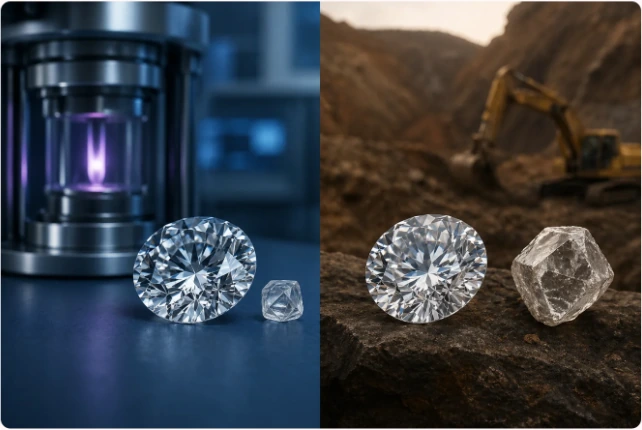
Lab grown diamonds come in several shades, including colourless, yellow, blue, pink and brown, with each shade developing because of tiny differences inside the diamond during growth or changes made afterwards through special treatments.
Why Do Diamonds Have Different Shades?
- Diamonds are made of carbon, but tiny amounts of other elements can enter during growth and give them a visible colour.
- Nitrogen can make a diamond look yellow, while boron can give it a blue shade, even when these elements are present in very small amounts.
- Small changes in how the carbon atoms fit together can also affect colour by changing the way light passes through the diamond.
- Some shades develop while the diamond grows, while others appear after carefully controlled treatments involving heat or irradiation, a process that changes tiny features inside the stone.
Colourless Diamonds
- Colourless diamonds look clear without an easily noticeable yellow, brown or other tint because very little inside them produces visible colour.
- These diamonds can grow with a colourless appearance, although some initially have a slight tint that is reduced through treatment after growth.
- Colourless does not mean milky or cloudy, as a diamond’s colour and how clearly light passes through it are two different features.
- The rainbow flashes seen when a diamond moves come from light splitting into different colours, rather than from the diamond having a permanent rainbow shade.
Near-Colourless Diamonds
- Near-colourless diamonds look clear at first glance but contain a slight tint that becomes easier to notice when compared with a colourless diamond.
- This tint is usually a gentle yellow or brown warmth caused by small amounts of other elements or tiny changes inside the stone.
- The colour may be easier to see from the side or against a plain white background than when looking directly at the top.
- Two diamonds grown in the same way can still have different levels of warmth because their growth conditions and internal features are not completely identical.
Yellow Diamonds
- Yellow diamonds usually get their colour from nitrogen that becomes part of the diamond while it grows, changing how the stone absorbs light.
- Their shades can range from a very light lemon tint to a stronger golden yellow, depending on the amount and arrangement of nitrogen inside.
- A small amount of yellow may appear as a faint warmth, while a stronger concentration of colour gives the diamond an obvious yellow appearance.
- Yellow lab grown diamonds can develop their colour during growth, so their shade does not always need to be created through treatment afterwards.
Blue Diamonds
- Blue diamonds can get their colour from boron, an element that enters the diamond during growth and changes the way it absorbs light.
- The shade can range from a barely noticeable blue tint to a deeper blue, depending on the stone’s internal features.
- Some diamonds look greyish-blue rather than pure blue because more than one feature inside the stone can influence its overall appearance.
- Blue and blue-green shades can also be created through treatment, which means looking at the colour alone cannot explain exactly how it formed.
Pink and Red Diamonds
- Pink and red shades are often produced after growth through special treatments that change tiny features inside the diamond.
- These treatments can involve irradiation followed by controlled heating, helping create internal changes that make the stone appear pink or red.
- The final appearance depends on the changes produced inside the diamond, so one stone may look softly pink while another has a stronger colour.
- Pink colour in a laboratory-grown diamond does not necessarily form in the same way as pink colour in a mined diamond, even when both look similar.
Brown and Champagne Diamonds
- Brown shades can develop when small irregularities form inside a diamond during growth, changing how it absorbs light and giving it a warmer appearance.
- Some diamonds grown using the CVD method, which builds a diamond from carbon-containing gas, initially develop a noticeable brown tint.
- Treatment after growth can reduce this tint, so a diamond that starts brown may eventually have a much clearer-looking appearance.
- Champagne and cognac are names used to describe lighter and deeper brown shades rather than separate kinds of diamonds or different methods of growing them.
Green Diamonds
- Green shades can be created through irradiation, which changes tiny parts of the diamond’s internal structure and affects how light passes through it.
- These changes can produce green or blue-green appearances, depending on the diamond’s original features and the treatment used.
- Heating after irradiation can change the colour further, so the final shade depends on the combination of treatments rather than irradiation alone.
Orange and Mixed Shades
- Orange shades can develop from nitrogen-related features inside the diamond, with treatment sometimes used to create or adjust the colour.
- Some stones show a mixture of colours, such as yellow-orange, brownish-pink or greenish-blue, because several internal features affect their appearance together.
- A mixed colour description gives a more accurate picture of the stone than calling it simply orange, pink or blue.
Understanding How These Shades Occur
- The colour of lab grown diamonds depends on what happens inside each stone during growth and whether it receives any colour-changing treatment afterwards.
- There is no fixed percentage for how often each shade occurs because producers use different methods and can aim to create particular colours.
- Specialist testing is needed to identify the cause of a diamond’s colour, as two stones with similar shades may have developed them differently.